Bow
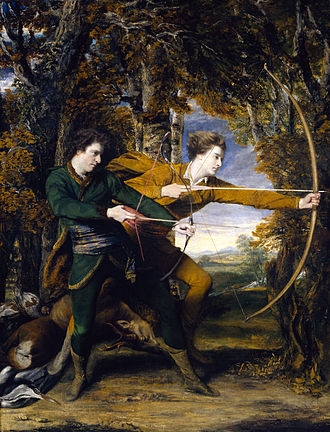
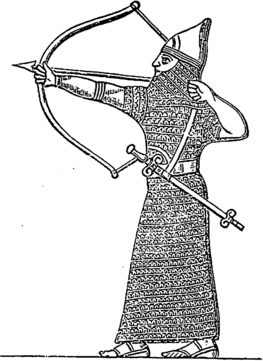
The bow is an individual ranged weapon designed for shooting arrows.
Before shooting, the archer draws back the pre-tensed bowstring, exerting force using the muscles of the arms, shoulders, and back. This effort is used to increase the potential energy of the bow limbs' bending deformation (the bowstring itself, due to its low elasticity, does not store significant energy).
At the moment of release, the limbs partially straighten, the bowstring returns to its original position, and the stored energy is transferred to the arrow, accelerating it forward. Part of the energy is also dissipated as vibrations in the bow limbs and eventually as heat loss.
The range of an arrow depends on the bow's construction, the bowstring's draw strength, and weather conditions. On average, arrows can fly up to 80 meters, depending on their arrowhead type.
The bow was gradually replaced in mass use by the crossbow (around the 4th century BCE) due to its ease of use and reduced physical requirements. In the Late Middle Ages, the bow was further displaced by firearms.
Length: 1–2 meters (depending on type)
Weight: 0.5–2 kg
Period of Use: Since prehistoric times, gradually phased out after the 16th century
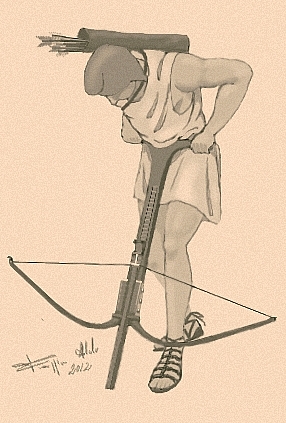
Crossbow (Arbalest, Self-Bow)
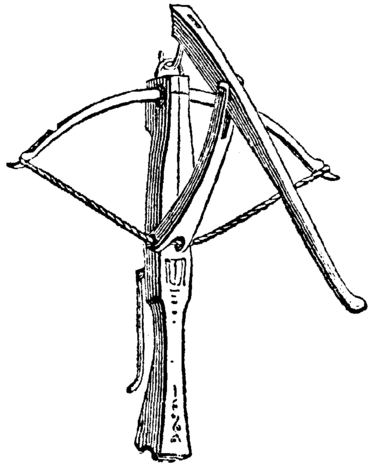
The crossbow is a ranged weapon used for both combat and sport.
It consists of a bow mounted on a stock, equipped with mechanisms for drawing and releasing the bowstring.
The crossbow, with very few exceptions, surpassed traditional bows in accuracy and stopping power, but generally had a lower rate of fire. Its popularity was due to the fact that training to use a crossbow took significantly less time compared to mastering the bow.
Crossbows fired bolts—shorter, thicker arrows that were often heavier than regular arrows. Some crossbows were even designed to fire lead bullets.
In warfare, both handheld crossbows and larger mounted versions were used. These large siege crossbows, called arcubalists, were frequently placed on mobile platforms and used as siege weapons.
Length: 50 cm to 1.5 meters
Weight: 2–10 kg
Country of Origin: Ancient China, Ancient Greece, later widely used in Europe
Period of Use: 4th century BCE – 17th century CE (military use), modern use in sports and hunting


Chu-Ko-Nu (Repeating Crossbow)
The Chu-Ko-Nu is a Chinese repeating crossbow that allows for rapid-fire shooting. The invention of the Chu-Ko-Nu is attributed to Zhuge Liang (181–234 CE), a famous Chinese strategist.
This crossbow features a lever mechanism, enabling the user to draw the string, load a bolt, and fire with a single hand movement. Equipped with a magazine for bolts, the Chu-Ko-Nu drastically improved firing speed compared to standard crossbows.
However, the last recorded mass military use of this weapon occurred during the First Sino-Japanese War (1894–1895 CE).
Length: ~1 meter
Weight: 3–6 kg
Country of Origin: China
Period of Use: 3rd century CE – 19th century CE
Primary Use: Warfare, defense, and later ceremonial use