

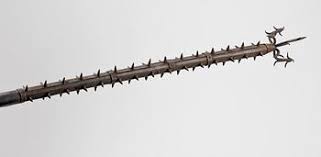
Sodegarami
Sodegarami is a Japanese pole weapon classified as a battle grappling hook. It was used by the Edo-period police to capture criminals.
Sodegarami featured a long wooden shaft with a spiked metal head. The spikes were necessary to prevent the criminal from grabbing the weapon. It evolved from the naval weapon Yagara-Mogara, which was originally used for defense against pirates.
The name Sodegarami translates to "entangling the sleeve." The weapon was designed to tangle an opponent’s clothing, immobilizing them. Once the opponent was restrained, they could be subdued without bloodshed.
Length: 2–2.5 meters
Weight: 3–5 kg
Country of Origin: Japan
Period of Use: Edo period (1603–1868)
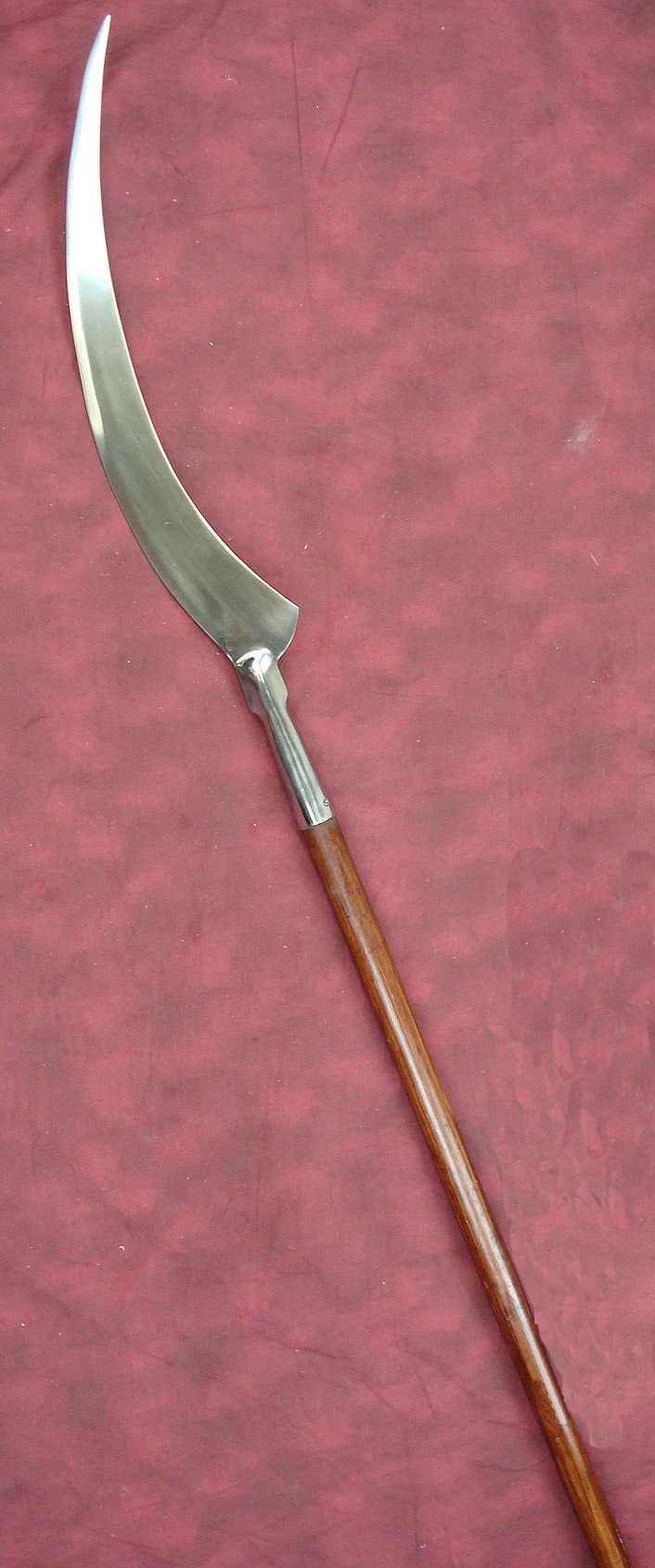
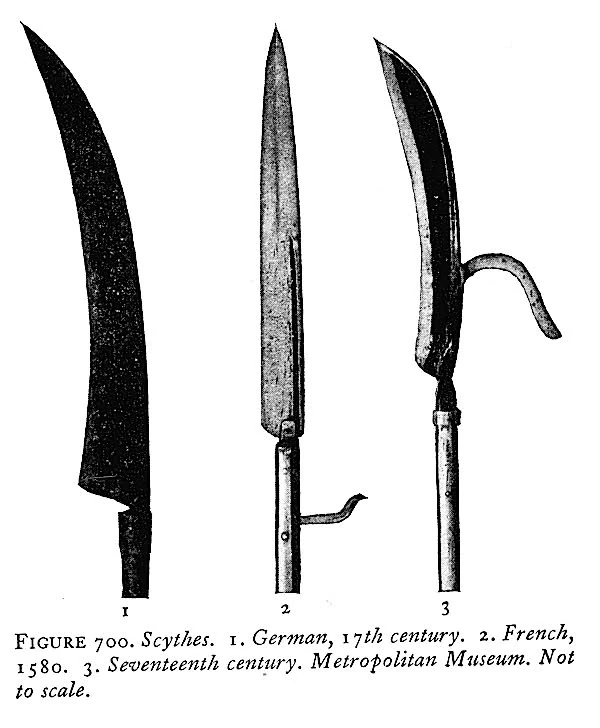
War Scythe
Primary Use: Law enforcement and criminal apprehension
The war scythe is a pole weapon used by infantry. It consisted of a wooden shaft or pole with an attached farming scythe blade, a cleaver-like knife, or a specially crafted dual-edged curved blade.
The blade was mounted so that its cutting edge was aligned with the shaft.
This weapon was widely used by Polish and Belarusian rebels, where it was as popular as the common pike. It provided a practical and effective weapon for poorly armed revolutionaries.
Length: 1.5–2.5 meters
Weight: 2.5–4 kg
Country of Origin: Poland, Belarus
Period of Use: 16th–19th centuries
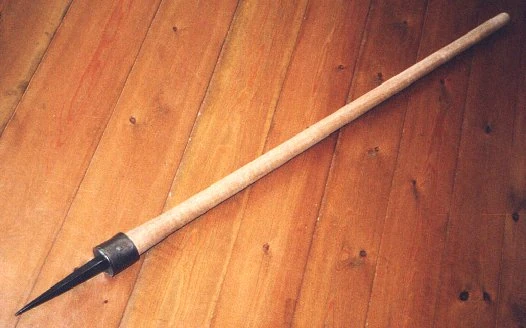
Goedendag
Goedendag (Dutch: "Good Day") is a medieval pole weapon of striking and thrusting action—a heavy club about the height of a person, with a widening shaft reinforced with iron and tipped with a sharp spike.
It was most commonly used in 14th-century Flanders.
The most well-known theory about its name links it to the "Bruges Matins" uprising of 1302, where Flemish rebels slaughtered Frenchmen by testing their pronunciation of certain Dutch words.
Length: 1.2–1.5 meters
Weight: 3–6 kg
Country of Origin: Flanders (modern Belgium)
Period of Use: 13th–14th centuries


Bearded Axe
The Bearded Axe (Skeggox) is a type of battle axe featuring a straight upper edge and an extended downward-curving "beard" on the blade. This design allowed for better control of chopping strikes, an increased cutting surface, and the ability to hook an opponent’s weapon or shield.
The sharp and extended cutting edge of the bearded axe ensured deep penetration into armor, making it highly effective against chainmail and leather armor.
Some historians consider bearded axes as uniquely Scandinavian weapons, extensively used by Vikings in both combat and daily life.
Due to the lowered center of gravity, the axe could be wielded with either one or two hands, providing precision and powerful strikes.
It was a versatile tool that also had practical applications in carpentry and woodwork.
Length: 60–120 cm
Blade Length: 15–30 cm
Weight: 0.8–2 kg
Country of Origin: Scandinavia
Period of Use: 8th–11th centuries