

Espada Ropera
Espada Ropera (Spanish: "Dress Sword") is a long, one-handed, narrow sword with a Spanish-style hilt, featuring a pronounced ricasso and fuller, as well as a double-edged blade that tapers to a sharp point.
It was used by Spanish infantry, nobles, and, less commonly, cavalry during the Late Middle Ages and the Renaissance. It first appeared in Spain in the 15th century.
The blade is essentially a transitional form between the Spanish sword and the Baroque-era rapier but differs from rapiers in its ability to cut as effectively as it thrusts.
Weight: Approximately 1–1.5 kg
Length: 100–130 cm (blade length ~90–110 cm)
Country of origin: Spain
Time/place of use: 15th–17th centuries, Europe

Ma Ya Zi
Ma Ya Zi (Horse Teeth) — a rare type of Shaolin cold weapon.
Ma Ya Zi originates from the Chinese sword Jian, and has similar dimensions, except for the blade width.
Both blades are covered with serrations along their entire length, resembling horse teeth, which is where the name "Ma Ya Zi" comes from. The tip of the blade is shaped like the plant Arrowhead.
There are 12 spikes on each side of the blade, with half facing downwards from the center and the other half facing upwards, dividing the spikes into Yin and Yang spikes.


Jian
Jian is a Chinese straight sword, typically with a blade length of around 1 meter, though in the Bronze Age, the blade length was less than 1.5 meters.
The Jian sword is one of the oldest types of swords, appearing around 1000 - 700 BC, and used as a combat weapon until the Tang Dynasty (618 - 907 AD).
The Jian sword became most widespread during the Warring States Period, from the 5th century BC to 221 BC.
During the Tang Dynasty, Jian been replaced with Dao sword, which itself evolved from the Jian. However, the Jian continued to be used for ceremonial purposes until World War II.

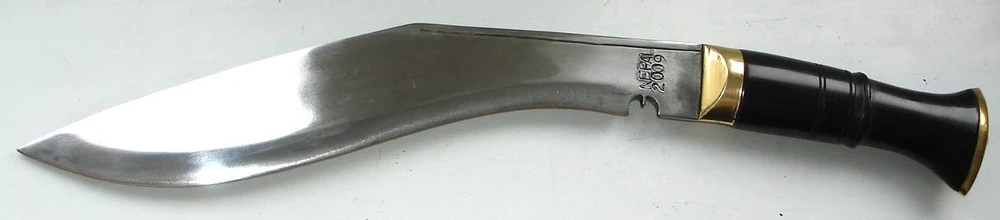
Khukuri
This weapon is one of the few examples that appeared in the Middle Ages and has remained virtually unchanged until today.
Initially, it was a household item used by the people of Nepal in their daily lives.
However, in 1815, during the defense against British aggression, the Khukuri became practically the only weapon of the Gurkhas, which forced the British to retreat.
The Gurkhas then joined the service of their former enemies and have been serving for almost 200 years.


Zweihander
Zweihander is a type of sword used by Landsknechts (mercenaries) with a double hilt, and it had a specific dual guard, where a small guard, called “wild boar’s tusks,” separated the unsharpened portion of the blade (ricasso) from the sharpened part.
The unsharpened portion of the blade, called the strong, was typically the thickest and strongest part of the sword, used for blocking without fear of damaging the blade (or creating chips).
For this reason, the sword was often gripped with both hands, increasing leverage for powerful strikes, which is why the small guard existed.


Flamberg
Flamberge (from German "Flame") — a two-handed (less often one-and-a-half-handed) sword with a wavy (flame-like) blade shape.
A thrust with a Flamberge caused significantly more severe wounds to the opponent than a strike with a regular sword blade. The wounds inflicted by the Flamberge often did not heal.
The effect of the Flamberge was primarily in the waves passing through the victim’s body, which left a jagged wound with several parallel cuts inside, which, considering the level of medieval medicine, almost always became infected, causing gangrene.
Flamberge wielders were feared and hated by their opponents, and the swords were cursed by the Catholic Church and prohibited for use as inhumane weapons.
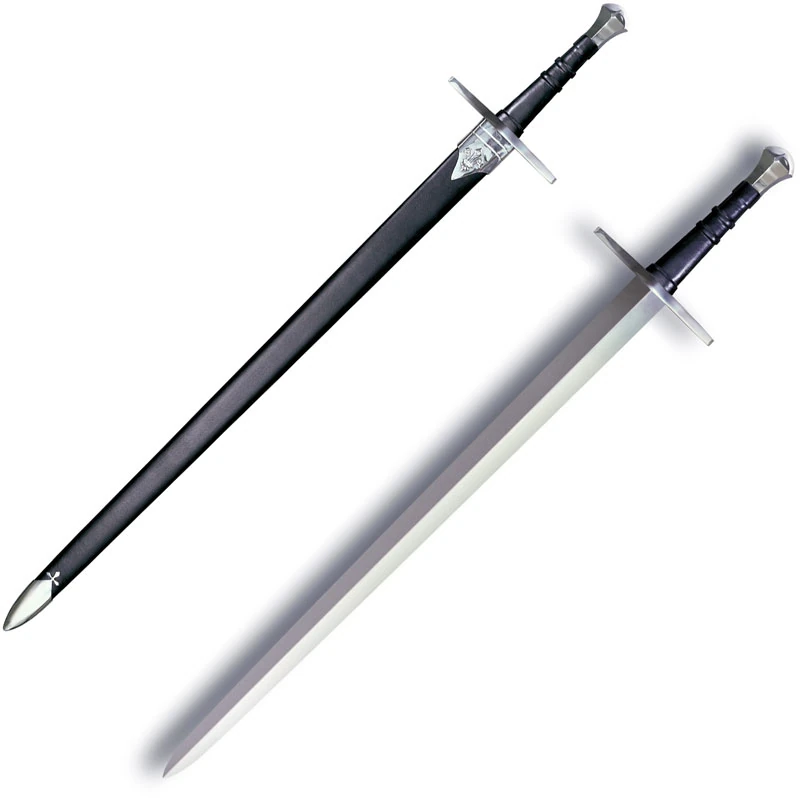

Bastard Sword / Longsword
Bastard Sword or Longsword — a type of blade weapon that formed the core of Western European knightly arsenals in the 14th-15th centuries.
It appeared in Europe in the first third of the 14th century, as plate armor, which was resistant to single-handed swords, began to spread.
The new weapon featured a longer and bulkier hilt that could be gripped with either one or two hands, and a blade of up to 1 meter in length, designed for both cutting and thrusting strikes.
The bastard sword was well-balanced and could be used either single-handedly or in combination with a shield or other close-combat weapons.


Khopesh
Khopesh (from "the front leg of an animal") — a type of cold weapon used in Ancient Egypt.
The Khopesh resembled a Yataghan in appearance.
It consisted of a crescent-shaped cutting blade (a semi-circular blade) and a handle.
The crescent-shaped Khopesh was not a true sword (which evolved from daggers), but it was closer to a battle axe in its origin.
However, unlike its ancestor, the Khopesh caused not hack-like wounds but wounds similar to those inflicted by sabers.