
Hand Cannon (Ruchnitsa, Couleuvrine)
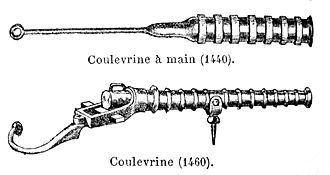
The hand cannon was an early European smoothbore muzzle-loading firearm, considered the ancestor of the arquebus, musket, and light cannon.
It was primarily used to engage enemy personnel at close range. Hand cannons were produced in both stationary and portable versions.
Used between the 15th and 18th centuries, they served as either small arms or light artillery weapons.
Eventually, portable hand cannons were replaced by arquebuses, which offered better handling and accuracy.
Length: 50–150 cm
Weight: 3–10 kg
Country of Origin: Europe
Period of Use: 15th–18th centuries
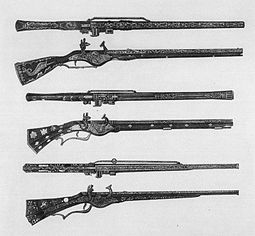
Musket
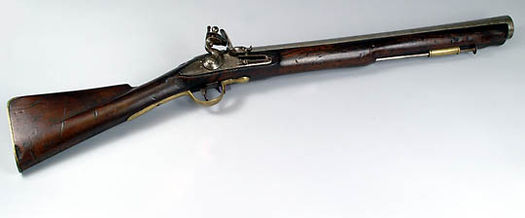
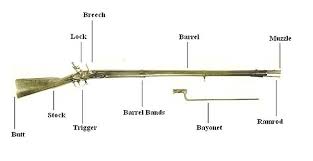
The musket was an early smoothbore matchlock firearm, appearing in the 16th century to accommodate the need for larger calibers and heavier bullets.
Initially, muskets were the heaviest form of handheld firearms, specifically designed to penetrate armored targets. One theory suggests that Spain introduced the first musket in 1521. The rise of plate armor in infantry units led to the development of muskets since lighter arquebuses and hand cannons struggled to pierce reinforced armor.
The introduction of granulated gunpowder made loading long-barreled firearms easier, while improvements in barrel forging allowed for longer and more efficient barrels.
Early muskets were essentially small cannons carried by a single soldier with no major design differences from artillery pieces.
Muskets fired round lead bullets, stones, or even scrap metal wrapped in cloth.
They featured a touch hole at the breech, where priming powder was placed. The shot was ignited using a match cord or a fire-starting stick soaked in saltpeter.
Length: 120–160 cm
Weight: 5–9 kg
Country of Origin: Spain
Period of Use: 16th–18th centuries
Carbine
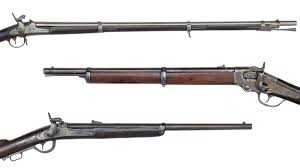
A carbine is a shorter and lighter version of a rifle.
The term "carbine" originated in Europe during the late 16th century, particularly in Spain. Initially, it referred to any firearm used by mounted soldiers (carabiniers), including arquebuses and wheellock pistols.
By the early 17th century, a new firearm type called the mousqueton (French) or blunderbuss (Dutch) emerged. In Russia, this short-barreled firearm was categorized as a carbine, although the musketoons (blunderbusses) were typically used as close-range weapons, including naval boarding firearms.
The first Russian carbine appeared in 1731, by which time the term "musketoon" had already become associated with shotguns and blunderbusses.
Length: 80–110 cm
Weight: 2.5–4.5 kg
Country of Origin: Spain
Period of Use: 16th century–modern times

Bamboo Fire Lance
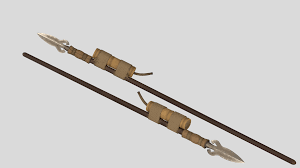
The bamboo fire lance was an early form of gunpowder weapon, bridging the gap between handheld weapons and artillery.
First appearing in China in 1230 CE, the fire lance gained widespread use under the Ming Dynasty army.
It consisted of a spear with a 60 cm bamboo or paper tube attached behind the spearhead. The tube was wrapped in rope and filled with gunpowder. When ignited, it would emit continuous flames for approximately 5 minutes, projecting fire up to 1.8 meters forward.
Length: ~2 meters
Weight: 3–6 kg
Country of Origin: China
Period of Use: 13th–15th centuries